Why Cheap Mold Tests Often Miss the Real Problem
A $40 hardware store kit feels like a smart, budget-friendly first step. In practice it is one of the most common ways York County homeowners end up with a false sense of security - and, months later, a much larger mold problem. Here is what those tests actually miss, and why professional inspection is the only reliable answer.
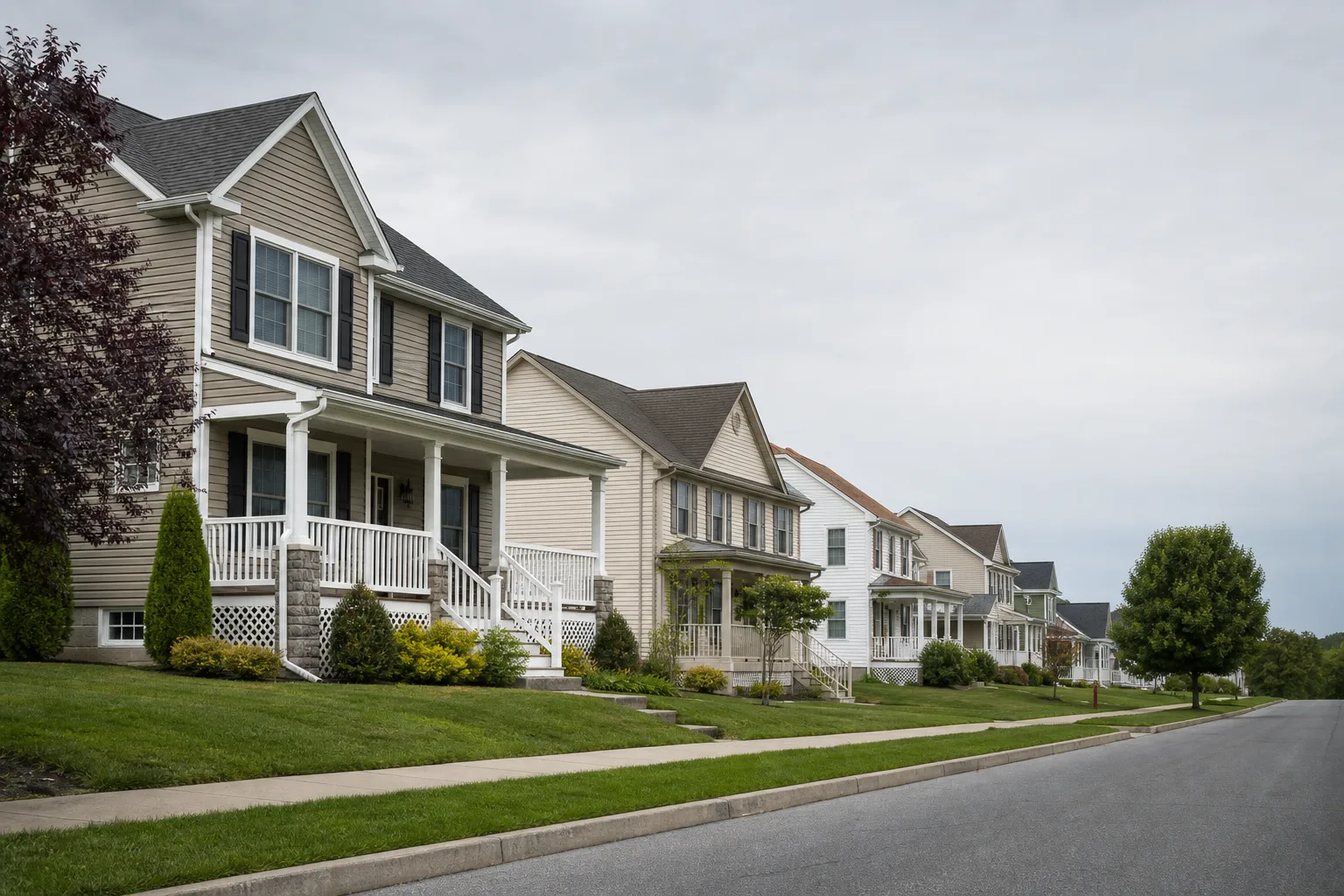
In neighborhoods like this across York County, cheap mold kits sit in kitchen drawers - and hidden mold keeps growing behind the walls.
Every week Tom fields a version of the same call. A homeowner in Dover, Red Lion, or Springettsbury Township noticed a musty smell in the basement. They drove to the hardware store, bought a $30 mold test kit, followed the instructions, mailed off the sample, and got a report back. The report said either "mold detected" (and they panicked) or "no mold detected" (and they relaxed). Six months later they are calling for a real inspection - either because the panic did not go away, or because the smell got worse and the reassurance was clearly wrong.
This article is not an attack on homeowners who buy those kits. The instinct is understandable: something feels off in the house, a $30 kit exists that claims to answer the question, so of course you try it first. The problem is not the homeowner. The problem is that cheap mold tests are engineered to sell reassurance, not to diagnose a home.
What follows is a plain-language walkthrough of exactly what a $20-$40 mold test does, what it does not do, and why - in almost every case - it either produces a result the homeowner cannot act on or actively misleads them. If you are considering one, read this first. And if you have already used one, this will explain why the result may not mean what you think it means.
The Short Version
Cheap mold tests tell you spores exist. Spores always exist - mold is a normal component of outdoor and indoor air. What a real inspection tells you is whether spore levels inside your home are elevated relative to outside, where the source is, why it is there, and what to do about it. Without those four answers, you do not have information you can act on.
Four Things a $40 Kit Cannot Give You
Each of these is critical to making a real decision about the home. Cheap tests skip all four.
Location of the Actual Growth
A $40 petri dish sitting open on your kitchen counter tells you spores were in the air. It does not tell you whether the source is a wall cavity behind the bathroom vanity, the crawl space subfloor, a leaking HVAC condensate line, or simply the outdoor air drifting in through an open window. Without location, you cannot fix anything.
Accredited Lab Analysis
Most cheap kits ask you to visually identify colonies on a growth medium - or ship them off to a mail-order lab that is not accredited. Without an AIHA-accredited laboratory running the analysis, the numbers cannot be relied on for real decisions, insurance claims, or real estate negotiations.
Moisture Source Identification
Mold does not appear without moisture. Every meaningful inspection includes moisture meter readings, thermal imaging of exterior walls and ceilings, and a walkthrough of the plumbing, drainage, and HVAC systems. A cheap test skips all of that - so even a positive result leaves you with no plan.
An Outdoor Baseline for Comparison
Air sampling only means something when the indoor result is compared to an outdoor control sample taken the same day. Cheap tests almost never include a paired outdoor baseline - which means any number they produce is unreadable. High compared to what?
How a Cheap Kit Actually "Tests" Your Home
Most hardware store kits are one of three things: a settle plate (an open petri dish with growth medium inside), a swab that scrapes visible growth, or a tape lift for surface sampling. All three can produce data - but only when handled and interpreted correctly. Handed to an untrained homeowner with no controls, none of them produce a defensible result.
A settle plate is the most common cheap kit. You open the dish, place it in the room, and wait an hour (or overnight) while spores from the air settle onto the medium. Then you seal it, wait several days for growth, and either mail it in or visually assess the colonies.
Here is the problem. Spore counts settle unevenly based on air currents, HVAC activity, foot traffic, humidity, temperature, and time of day. A settle plate on the counter next to an active HVAC return will capture wildly different results than the same plate on a bookshelf twelve feet away. There is no calibrated air pump pulling a known volume of air across the medium - which is what an accredited air sample does. Without volume control, you cannot calculate spore concentration per cubic meter of air, which is the number that actually matters.
This is why professional inspections use an Air-O-Cell cassette or comparable sampling device. A calibrated pump draws exactly 75 liters of air across a known collection surface over a measured period. That sample goes to an AIHA-accredited lab where a microbiologist counts and identifies spores under a microscope. The result comes back as spores per cubic meter, compared against an outdoor control taken the same day at the same property. That is data you can act on.
Why Homeowners Reach for the Cheap Kit First
The reasoning is understandable. The math does not hold up.
“They cost $20-$40 at the hardware store”
Which is why they exist. The margin on a $40 test kit is much higher than the value the kit delivers. You are paying for shelf space and packaging - not for defensible data.
“Homeowners want quick reassurance”
A quick answer that is wrong is worse than a slower answer that is right. A false negative from a cheap test can convince a family to keep living with a hidden mold problem for months longer than they otherwise would.
“The packaging says "lab analysis included"”
Read the fine print. Many kits require you to mail the sample yourself and pay an additional $40-$60 per sample for the lab work. The bundled price you saw at the store was just the sampling media.
“"Something is better than nothing"”
Not when the something misleads you into wrong action. A cheap test that produces a false positive can lead to unnecessary remediation costing thousands. A false negative can let a real problem grow.
Seven Red Flags on a Cheap Mold Test
If a test kit does any of the following, it is not going to give you an answer you can rely on. These are the same warning signs professional inspectors look for when a homeowner brings them a prior kit result.
What a Real Inspection Includes
- Full walkthrough of every affected area with a certified inspector.
- Calibrated air sampling with an outdoor control taken the same day.
- Moisture meter readings on walls, floors, and framing.
- Thermal imaging to locate hidden moisture behind finished surfaces.
- AIHA-accredited lab analysis with spores identified to genus.
- Written report with photos, findings, and specific next steps.
What Cheap Actually Costs
The $40 you save on the kit is almost never the number that ends up mattering.
Cheap DIY kit, false negative
$40
Hidden mold continues growing for 6-18 months. Eventually discovered during a real estate transaction or after health symptoms escalate. Remediation cost: $4,000-$10,000+.
Cheap DIY kit, false positive
$40
Homeowner panics, calls a remediation company, gets a $5,000 quote based on a kit result the remediator cannot verify. Money spent without confirmation the problem was ever real.
Cheap DIY kit, ambiguous result
$40
Numbers on a page with no context. Homeowner still does not know what to do. Ends up calling a professional inspector anyway - so the kit was wasted money.
Professional inspection with accredited lab work
$300-$500
Exact location and extent confirmed. Moisture source identified. Species reported. Written report with photos and lab results. Remediation (if needed) is scoped precisely - or ruled out entirely.
For a deeper look at the math, see why testing first saves time and money and testing vs. remediation: the difference.
Why Cheap Tests Fail York County Homes in Particular
York County has a specific combination of housing characteristics that makes DIY testing especially unreliable here. The older sections of York, Wrightsville, and Hanover contain thousands of pre-1950s homes with stone foundations, balloon-frame construction, and unvented crawl spaces. Newer developments in Dover Township, Manchester Township, and Springettsbury Township have finished basements, complex HVAC systems, and moisture intrusion pathways that a settle plate on a living room table will never detect.
In an older York home the mold problem is almost always somewhere the homeowner cannot see - in the stone foundation joints, on the underside of the subfloor, or in the plaster wall cavities. A settle plate in the kitchen will not sample any of that. In a newer finished basement the mold is usually behind the drywall or above the drop ceiling. Again, an air sample taken by the couch tells you nothing about what is happening on the other side of the finished surface.
This is where thermal imaging, moisture mapping, and targeted cavity sampling actually matter. Tom regularly finds significant mold growth in wall cavities and crawl spaces at homes where prior DIY kits came back "clean." See thermal imaging inspection and moisture intrusion inspection for the two tools that most often locate what cheap tests miss.
The pattern is location-specific too. In York, stone-foundation seepage. In Dover, high-water-table crawl spaces. In Hanover, aging attic ventilation and roof leaks. In Red Lion and Dallastown, older housing stock with mixed finished-basement retrofits. Each of these patterns requires an inspector who knows what to look for. A generic $30 kit does not.
The Real Estate Problem
This is where cheap tests do the most damage. Buyers and sellers sometimes use a DIY kit to "screen" a home before closing, then use that result as leverage - or as a reason to skip a real inspection. That is a mistake for both sides.
A DIY kit result carries no weight in a real estate negotiation. Lenders, attorneys, and title companies will not accept it. A seller cannot use it to prove the home is clean. A buyer cannot use it to negotiate remediation costs into the purchase price. Both parties end up back at square one - having to schedule a real inspection anyway, often on a shorter timeline than they would have preferred. See real estate mold inspection for how professional inspections protect both sides of a transaction, and how mold inspections smooth out real estate transactions for real-world examples.
Post-Remediation: Where a Cheap Test Is Actively Dangerous
The single worst use case for a DIY mold kit is verifying remediation. After paying thousands of dollars for professional remediation, homeowners sometimes buy a $30 kit to "confirm the job worked." The remediator often encourages this because a cheap kit is almost guaranteed to come back "clean" - even when the work was incomplete.
Clearance testing after remediation must be performed by an independent inspector using calibrated air sampling, matched to an outdoor control, with AIHA-accredited lab analysis. Anything less is not a clearance. See post-remediation verification mold inspection for what a real clearance test involves and why it matters.
If You Have Already Used a Cheap Kit
This section is for the homeowner who is reading this after the fact. You bought the kit, ran it, got a result, and now you are second-guessing what it means. Here is how to think about it.
If the kit came back "no mold detected" and you still have a musty smell, visible discoloration, health symptoms that improve when you leave the house, a history of water intrusion, or any moisture concern - the kit was wrong, or at least incomplete. A real inspection is warranted.
If the kit came back "mold detected" but you have no visible growth, no odor, and no moisture concern - do not panic. The result is probably picking up normal background outdoor spores that entered through open windows or on shoes and clothing. Before spending thousands on remediation based on a kit result, get an inspection that actually measures indoor levels against outdoor baseline and identifies where any real growth is located.
Either way, the next step is the same: an independent, accredited inspection that can either confirm or overturn what the kit told you. See what a professional inspection report should include so you know what to expect.
You Are Not Cheap - The Test Is
Trying to save money on a home problem is smart. Trying to save money with a tool that cannot actually diagnose the problem is not. A professional inspection typically costs 5-10% of the average remediation - and it is the only reliable way to know whether remediation is needed at all.
Related Resources
DIY Mold Tests: What They Miss
The full breakdown of everything a hardware store kit fails to capture and why professional inspections replaced them.
Professional Mold Inspection & Testing
What a complete residential mold inspection includes, from moisture mapping to accredited lab analysis.
ERMI Mold Testing
How ERMI dust sampling differs from air testing and when it is the right tool for the job.
Air Samples vs. Surface Samples
A clear explanation of the two most common professional sampling methods and when each is used.
Why Testing First Saves Time and Money
The math behind why an inspection before remediation almost always costs less than remediation without one.
What an Inspection Report Should Include
How to evaluate whether a mold inspection report is thorough enough to be useful.
Get an Answer You Can Actually Use.
Call or text Tom directly. Whether you have already used a DIY kit or are trying to decide whether you need one, an honest conversation is the fastest way to figure out the right next step.