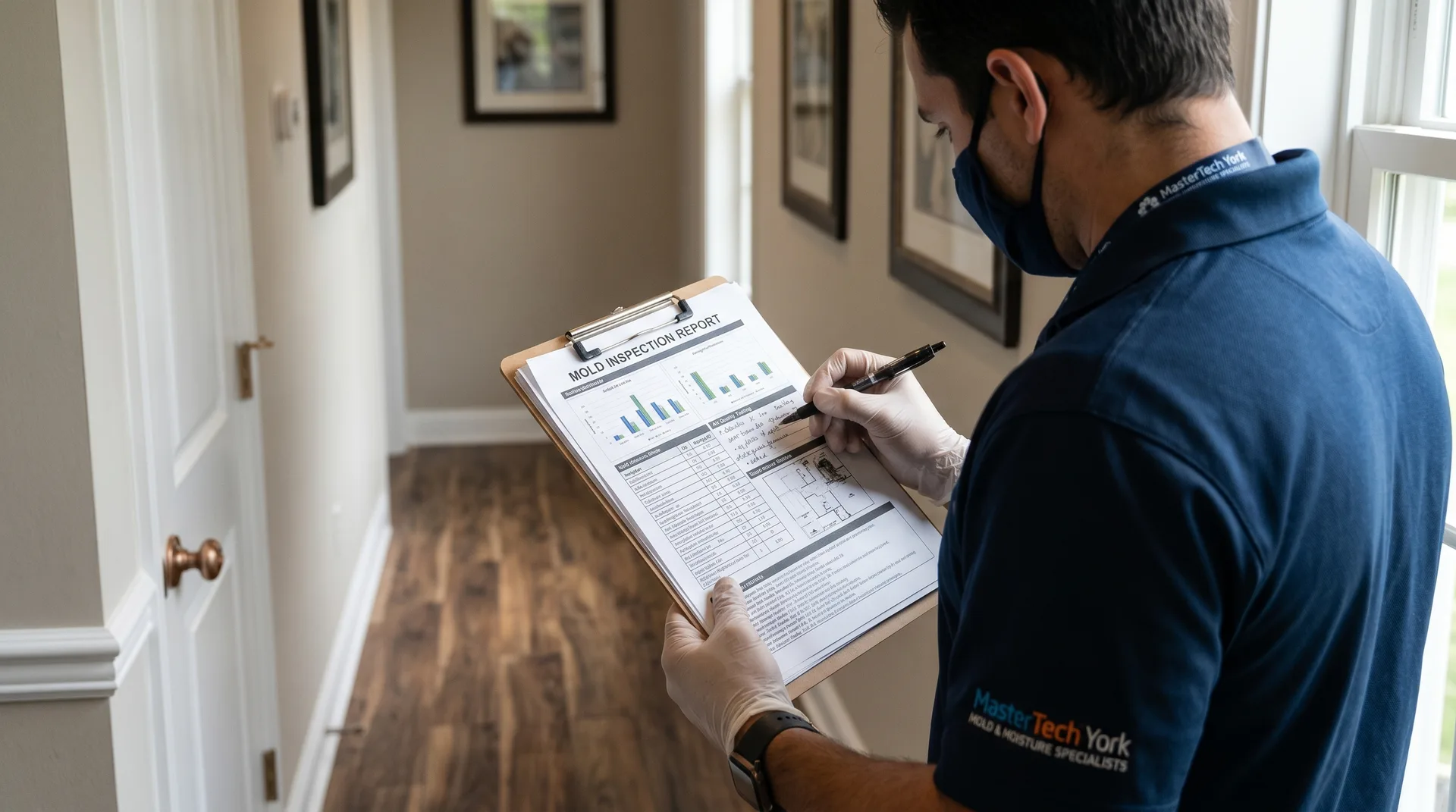
Mold Inspection Results & Next Steps
Understanding Your Mold Inspection Report
Lab reports, spore counts, and moisture readings can be confusing. This guide walks you through exactly how to read your mold inspection report - what each section means, the key terms defined, and how to tell a good report from a bad one.
How to Read Your Report in 5 Steps
Follow these steps in order to get the most out of your mold inspection report.
Step 1
Start With the Summary Section
Every professional report begins with a plain-English summary. Read this first. It tells you whether action is needed, where the problems are, and what the inspector recommends. If the summary says the home is within normal ranges, the rest of the report is supporting documentation.
Step 2
Compare Indoor vs Outdoor Counts
Find the air sample results table. Look at the outdoor baseline sample - this was collected outside your home during the inspection. Now compare each indoor sample to that number. Indoor levels should be at or below outdoor levels. If any indoor location shows significantly higher counts, note which species and where.
Step 3
Identify the Species
Not all mold is equally concerning. Common outdoor species like Cladosporium appearing indoors at similar levels to outdoor is generally not alarming. Finding Stachybotrys or Chaetomium indoors - even at low counts - is significant because these species only grow with chronic moisture. Your inspector should explain the significance of each species found.
Step 4
Review Moisture Readings
The moisture section lists readings from throughout the home. Look for any readings above 16% in wood materials or above 20% in other building materials. High moisture readings in the same areas as elevated spore counts confirm the connection between moisture and mold growth. This also helps identify where the moisture source is.
Step 5
Read the Remediation Protocol (If Present)
If mold was found, the report should include a remediation protocol. This is a legal document describing exactly what work needs to be done. Read it carefully before getting bids from contractors. Any contractor bidding on the work should follow this protocol exactly - not substitute their own scope of work.
Key Terms Defined
Every term you'll encounter in a professional mold inspection report - explained in plain English.
Spore Count
The number of mold spores detected per cubic meter of air. Raw numbers alone are not meaningful - they must be compared to outdoor baseline samples collected at the same time.
Outdoor Baseline
An air sample collected outside the home during the same inspection. This is the reference point for all indoor comparisons. Healthy indoor air should have similar or lower spore levels than outdoor air.
Genera / Species
The type of mold identified. Some genera (like Stachybotrys) are more concerning than others (like Cladosporium). The species matters as much as the count.
Elevated
Indoor spore levels that are significantly higher than outdoor baseline levels. The threshold varies by species and inspector methodology, but generally 2x or more than outdoor is considered elevated.
Remediation Protocol
A written scope of work included in the report when mold is found. It describes what needs to be removed, how it should be cleaned, what containment is required, and what clearance criteria must be met.
Clearance Criteria
The standard that must be met after remediation for the space to be considered clean. Usually defined as indoor spore levels at or below outdoor baseline levels for the same species.
Moisture Reading
A measurement taken with a moisture meter, expressed as a percentage. Wood materials above 16-20% are considered elevated. Elevated moisture readings indicate conditions that can support mold growth.
Tape Lift / Surface Sample
A sample collected by pressing tape or a swab against a surface. Used to identify the species of visible mold growth. Does not provide information about air quality.
Red Flags in a Mold Inspection Report
Not all mold inspection reports are created equal. Here's what to watch for that indicates a low-quality or potentially biased report.
- No outdoor baseline sample included
- Only raw spore counts with no comparison or context
- No moisture readings or thermal imaging data
- Vague language like 'mold detected' without species identification
- No photos of areas of concern
- Remediation protocol written by the same company that will perform the work
- No explanation of what the findings mean for your health or home
- Report delivered without any opportunity to ask questions
What a Quality Report Looks Like
A MasterTech York inspection report includes a plain-English summary, all moisture readings, thermal imaging photos, lab results with outdoor baseline comparisons, species identification, and - when needed - a detailed remediation protocol.
Tom personally walks every client through their report and is available to answer questions. Reports are delivered digitally within 3-5 business days of the inspection.
Related Homeowner Guides
What a Mold Inspection Report Means
A section-by-section breakdown of every part of your report.
Understanding Mold Test Results
What spore counts actually mean in plain English.
What to Expect After a Mold Inspection
The full process from on-site visit to written report delivery.
What Is PRV / Clearance Testing?
Why post-remediation verification is essential after cleanup.
Need Help With Your Report?
Tom personally explains every report to his clients. If you have questions about your results or want to schedule a mold inspection, reach out directly.