Do You Need Mold Testing After a Wet Spring in York, PA?
York County's springs are consistently wet. If your basement took on water, developed a new smell, or your sump pump ran hard this season, here's how to decide whether mold testing makes sense - and what happens if you wait.
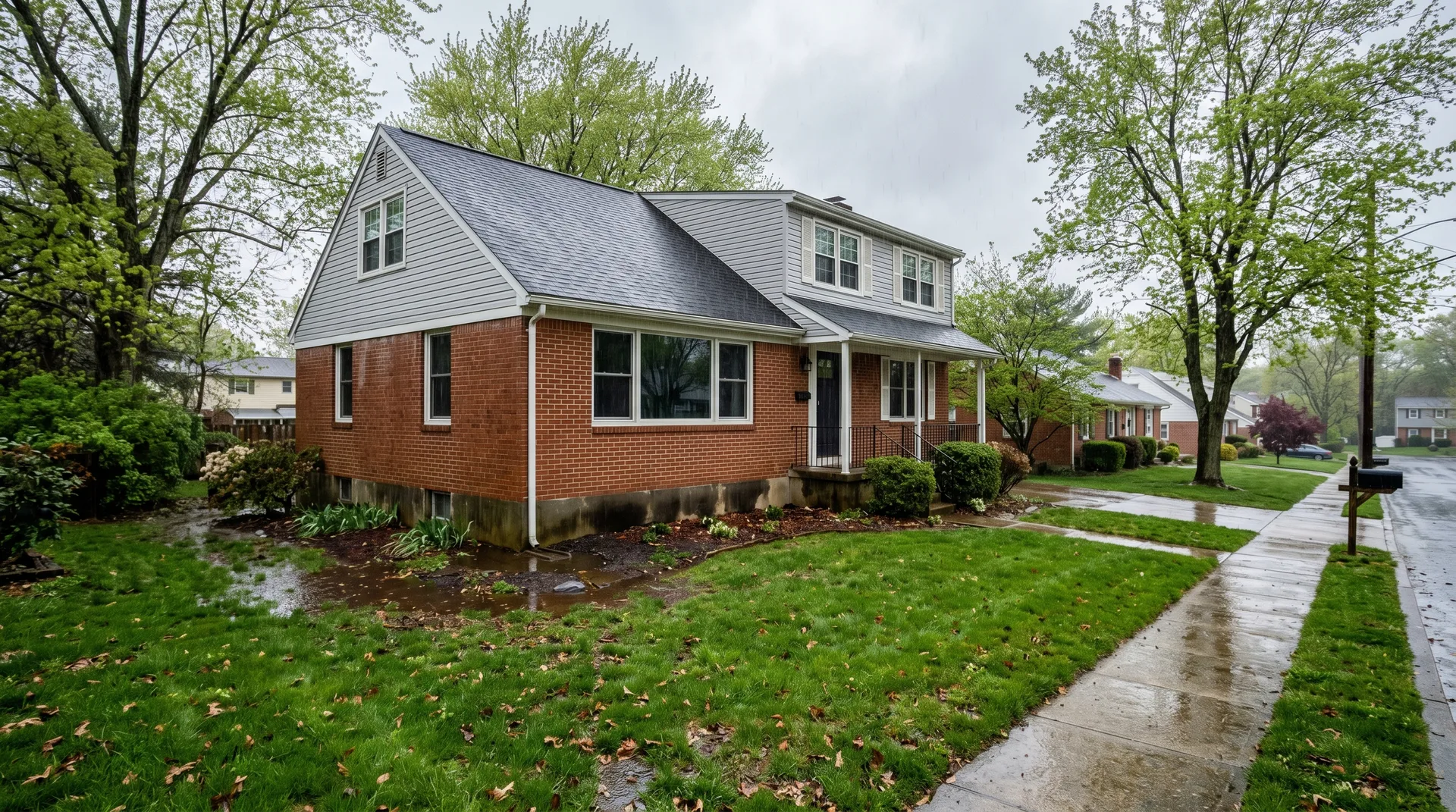
Saturated soil around York County foundations is one of the primary drivers of basement moisture and mold after a wet spring.
Spring in York County, Pennsylvania means rain. Lots of it. Between March and May, the region typically receives eight to twelve inches of precipitation - and that's in a normal year. In a wet year, total spring rainfall can push significantly higher, saturating the soil around foundations, overwhelming drainage systems, and pushing water into basements and crawl spaces that seemed perfectly dry all winter.
After a wet spring, the question Tom hears most often is some version of: "We got some water in the basement this spring - do we need to get tested for mold?" The honest answer is: it depends on what you're seeing, what you're smelling, and how long the moisture was present. But in many cases - more than most homeowners expect - the answer is yes.
This article explains the specific conditions that make post-spring mold testing worthwhile, what the testing process looks like, and what happens to your home and your health if elevated mold levels go undetected through the summer.
Why Spring Is the Highest-Risk Season for Mold in York County
Spring combines three conditions that mold requires to thrive: moisture, warmth, and organic material. Saturated soil around foundations drives water intrusion. Rising temperatures warm the interior of basements and crawl spaces. And organic materials - wood framing, drywall, cardboard, carpet - are present in abundance. By late spring, if moisture has been present since early March, mold has had weeks to establish itself inside your home's structure.
The York County Climate Factor
York County's geography and climate create a specific set of challenges for homeowners. The county sits in a valley surrounded by the South Mountain ridgeline and the Susquehanna River watershed - geography that channels precipitation and keeps the soil moisture levels consistently high through the spring months. Add to this the region's older housing stock, much of which was built before modern moisture management practices became standard, and you have a combination that makes post-spring mold issues extremely common.
Many York County homes were built in the 1940s through 1970s with stone or block foundations that were not designed with waterproofing membranes. Crawl spaces from this era often have no vapor barriers or aging ones that have deteriorated. Drainage grading around homes settles over decades, sometimes directing water toward the foundation rather than away from it. These structural realities mean that a wet spring is not just an inconvenience - it is a genuine mold risk event for a large portion of the housing stock in this area.
If you live in York city, West Manchester Township, Springettsbury Township, Dover, Dover Township, Manchester Township, Red Lion, Dallastown, or any of the surrounding York County communities, your home's construction era and local hydrology make it worth taking a wet spring seriously from a mold standpoint.
6 Signs That Mold Testing Makes Sense After This Spring
If any of these apply to your situation, a professional mold inspection is a reasonable next step.
Water in the Basement or Crawl Space
High PriorityIf you found standing water, a wet floor, or water stains along the base of your foundation walls after the spring rains, mold testing is strongly recommended. Mold can begin colonizing wet porous materials - concrete block, wood framing, drywall, stored cardboard - within 24 to 48 hours of a moisture event. By the time spring turns to summer, a water intrusion from April or May may already have a well-established mold colony behind it.
New Musty or Earthy Smell After Rain Events
High PriorityIf your basement, crawl space, or lower level of your home developed a new musty or earthy odor following a wet stretch of weather, that smell is not coincidence. It is a byproduct of active mold metabolism - specifically microbial volatile organic compounds (MVOCs) being released as mold digests organic material in your home's structure. A new smell that correlates with rain events is a reliable indicator that moisture is getting in somewhere and biology is responding to it.
Visible Staining or Discoloration on Walls or Floors
Moderate to HighNew water staining, efflorescence (white mineral deposits on concrete), or dark discoloration on basement walls or floors following a wet spring are all signs that water has been moving through or around your foundation. Even if the staining looks minor, it documents a moisture pathway that is likely to support mold growth on nearby organic materials like wood joists, stored items, or drywall.
Sump Pump Running Constantly or Overflowing
ModerateA sump pump that ran continuously through the spring or that struggled to keep up with water intrusion is a sign that your basement was under significant hydrostatic pressure. Even if the sump pump kept the floor dry, elevated moisture levels in the surrounding concrete and wood framing can be enough to sustain mold growth. If your pump ran hard this spring, a moisture assessment is worth doing before summer humidity compounds the problem.
HVAC System That Sat Idle Through a Wet Period
Often OverlookedIf your air conditioning was not running during a prolonged wet and humid spring stretch - which is common in York County from March through May - indoor humidity can climb well above the 60% threshold where mold thrives. HVAC systems that sit idle during high-humidity periods are also prone to mold growth on the evaporator coil and in the drain pan, which then gets distributed throughout the home when the system starts up again in late spring.
Crawl Space with Inadequate Vapor Barrier
Chronic RiskYork County has a large number of older homes with unconditioned crawl spaces that have either no vapor barrier or an aging, deteriorated one. A wet spring dramatically increases soil moisture levels under these homes, and that moisture migrates upward into the crawl space as vapor. Without an adequate barrier, wood floor joists and subflooring absorb that moisture continuously throughout the spring. By the time summer arrives, mold on floor joists is often well-established.
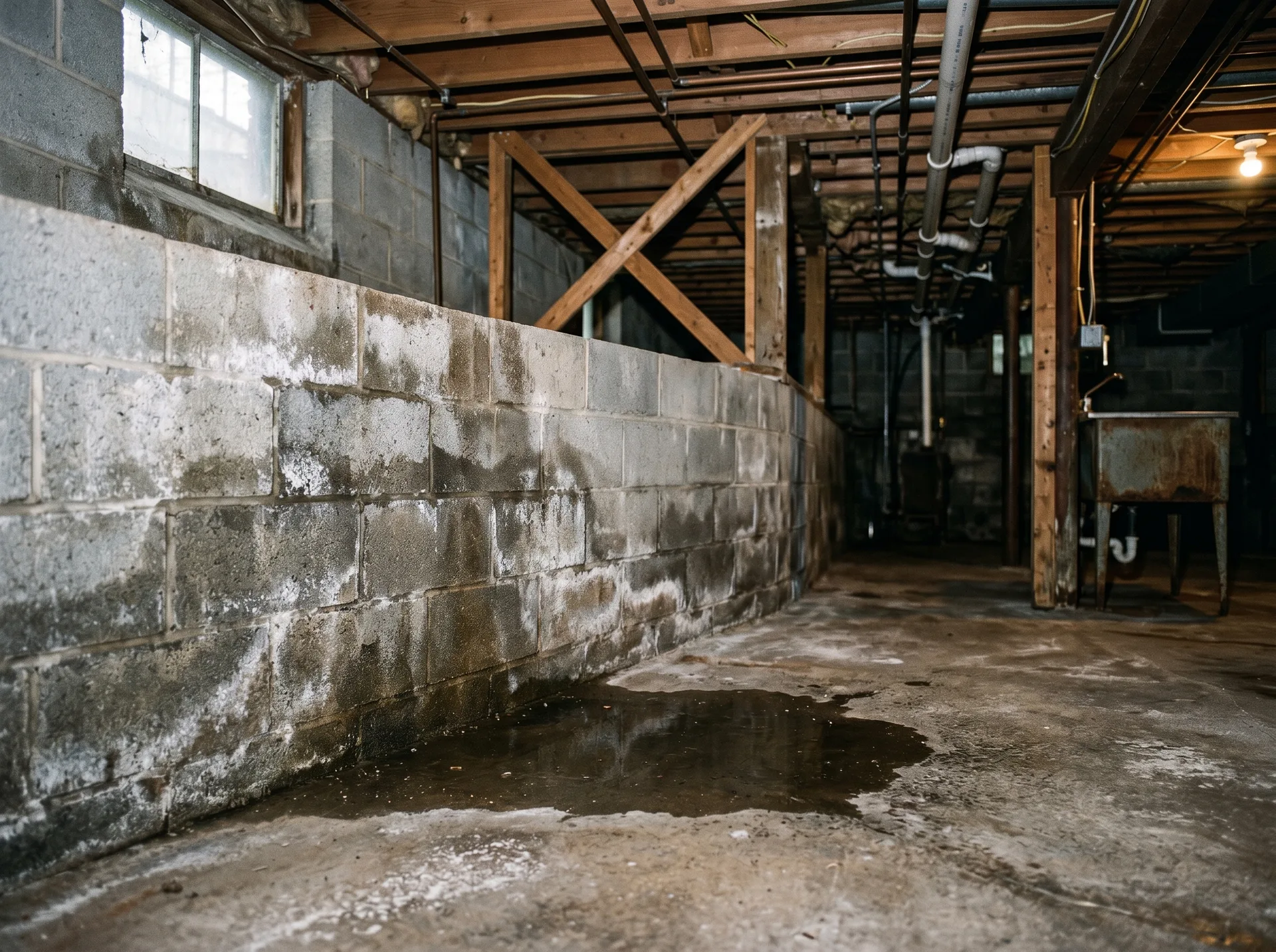
Moisture seeping through concrete block walls is one of the most common findings after a wet spring in York County homes.
What Happens If You Don't Test
The most common reason homeowners skip mold testing after a wet spring is that things seem fine by the time summer arrives. The basement dried out. The smell faded. Life got busy. The assumption is that if nothing is visibly wrong, nothing is actually wrong.
This assumption is often incorrect. Mold that established itself in a wet basement in April does not disappear when the floor dries in June. It goes dormant during dry periods and reactivates when humidity rises again - which in York County happens reliably every summer. By late July or August, when indoor humidity is high and the HVAC is cycling constantly, a mold colony that started in the spring can be producing significant spore loads.
The health implications of this cycle are real. Mold spores are respiratory irritants. For people with asthma, allergies, or compromised immune systems, elevated indoor spore counts cause measurable symptoms. For otherwise healthy adults, chronic low-level mold exposure can cause persistent fatigue, headaches, and upper respiratory irritation that are easy to misattribute to other causes. Learn more about how mold affects sinus issues and respiratory comfort and why mold makes breathing harder for asthma sufferers.
The financial implications are also real. A mold problem found in June, when it has been growing for six to eight weeks, is typically far less expensive to remediate than the same problem found in September, when it has been growing for five to six months. Early detection is not just about health - it is also about limiting remediation costs.
How Mold Progresses After a Moisture Event
The longer mold goes undetected after a wet spring, the more established it becomes and the more it costs to address.
Mold begins colonizing wet porous materials
Drywall, wood framing, cardboard, carpet backing
Small colonies establish and begin producing spores
Often still invisible but odor may begin
Visible growth may appear on surfaces
Spore counts in air can be significantly elevated
Established colony deeply embedded in materials
Remediation scope and cost increase significantly
Structural materials may be compromised
Health impacts more likely for sensitive occupants
The Window Between Spring and Summer Is the Best Time to Act
If your home had moisture issues this spring, the period between late spring and early summer is the optimal time for testing. Mold that established during wet weather will be detectable, but it has not yet had the additional fuel of summer humidity to grow further. Early testing means smaller remediation scope, lower costs, and a healthier home going into the hottest months of the year.
The Difference Between a Wet Basement and a Mold Problem
Not every wet basement becomes a mold problem. Whether moisture leads to mold depends on several factors: how long the moisture was present, what materials it contacted, how quickly the area dried out, and whether there was adequate air circulation during the drying process.
A concrete floor that had a half-inch of water for 24 hours and then dried completely within two days is a very different situation from a basement that had moisture seeping through the walls for three weeks and saturating wood framing, stored items, and drywall. The first scenario may not produce a significant mold problem. The second almost certainly will.
The challenge is that homeowners often cannot tell which scenario they are in without testing. Mold in wall cavities, behind stored items, on the back side of drywall, or on floor joists is not visible from a casual inspection. A professional inspection with moisture meter readings and air sampling can tell you definitively whether mold is present and at what levels - information you cannot get any other way.
Why Summer Makes an Undetected Spring Mold Problem Worse
York County summers are humid. Outdoor relative humidity from June through August regularly exceeds 70%, and on many days it reaches 85% to 90%. When that humid outdoor air enters a basement or crawl space - which it does constantly through foundation gaps, window wells, and vents - it raises indoor humidity to levels that are highly favorable to mold growth.
A mold colony that was established in the spring but went partially dormant during a dry stretch in May or June will reactivate aggressively when summer humidity arrives. The colony already has an established food source - the organic materials it colonized in the spring - and summer humidity provides the moisture it needs to grow rapidly. This is why mold problems that started in the spring are often discovered in late summer or fall, when they have grown to a scale that is impossible to ignore.
Running a dehumidifier can help slow this cycle, but it is not a solution to an existing mold colony. Dehumidifiers reduce ambient humidity but do not kill established mold or address the moisture source that fed it in the first place. If mold is already present, the only path to resolution is professional remediation - and the first step to knowing whether remediation is needed is professional testing.
What About the Crawl Space?
Crawl spaces deserve special attention in the post-spring context. Many York County homeowners have limited or no access to their crawl spaces and may not know what conditions developed there over the winter and spring. A crawl space with a dirt floor, inadequate vapor barrier, or poor ventilation is essentially a moisture trap during a wet spring.
Soil moisture levels under York County homes can remain elevated for weeks after the last significant rain event. That moisture continuously evaporates upward, raising the relative humidity inside the crawl space to levels that support aggressive mold growth on wood floor joists, subflooring, and any organic debris present. Because crawl spaces are out of sight, this growth often goes unnoticed until it is extensive.
If your home has a crawl space and you did not inspect it during or after the wet spring weather, that is a gap in your knowledge of your home's condition. A professional inspection that includes the crawl space is the only way to know what is actually happening down there. Learn more about mold on floor joists in York crawl spaces and why it is so common after wet weather.
When Testing Is Probably Not Necessary
In the interest of giving you a complete and honest picture: not every home that had rain this spring needs a mold inspection. If your home's basement stayed completely dry throughout the spring, your crawl space has a functioning vapor barrier and shows no signs of moisture, you are not noticing any new smells, and no occupants are experiencing unexplained respiratory symptoms - the case for testing is weaker.
Testing makes the most sense when there is a specific trigger: water intrusion, a new odor, visible staining, or symptoms among occupants. If you are genuinely uncertain whether your situation warrants testing, call Tom directly. He can talk through what you are seeing and help you make a reasonable decision without any pressure to schedule an inspection that may not be necessary.
The goal is not to create anxiety about normal seasonal moisture. The goal is to help York County homeowners make informed decisions about when the risk of untested mold exposure outweighs the cost of a professional inspection.
What a Post-Spring Mold Inspection Includes
A professional mold inspection after a wet spring is a systematic process that goes well beyond a visual check. Here's exactly what happens:
Visual Assessment of All Affected Areas
A thorough inspection covers the basement, crawl space, attic, all bathrooms, and any areas that showed signs of moisture intrusion during the spring. Tom looks for visible mold growth, staining patterns, efflorescence, and moisture damage that indicates where water has been traveling through the structure.
Calibrated Moisture Meter Readings
A moisture meter measures the moisture content inside building materials - concrete block, wood framing, drywall, and subfloor - without destructive testing. Elevated readings after a wet spring identify exactly which materials are still holding moisture and are most at risk for mold growth, even when no visible mold is present yet.
Air Sampling for Mold Spores
Calibrated air sampling equipment collects air from inside the home and from outside as a control. Samples go to an accredited laboratory that identifies and quantifies mold species. Elevated indoor spore counts compared to outdoor baseline levels confirm an active mold source inside the building envelope - even when the source is not yet visible.
Surface Sampling When Warranted
When visible growth or suspicious discoloration is found, surface samples confirm mold presence and identify the species. Species identification matters because some types are more concerning from a health standpoint and affect the urgency and scope of any recommended remediation.
Identification of the Moisture Source
Finding mold is only half the job. The inspection identifies the underlying moisture pathway - whether foundation seepage, inadequate crawl space vapor control, HVAC condensation, or drainage grading issues. Without addressing the source, mold returns after any remediation.
Written Report with Lab Results
You receive a written inspection report with all findings, moisture readings, photographs, and accredited lab results within one to two business days. This report gives you the documentation needed to make informed decisions about remediation and to verify that any work is actually necessary.
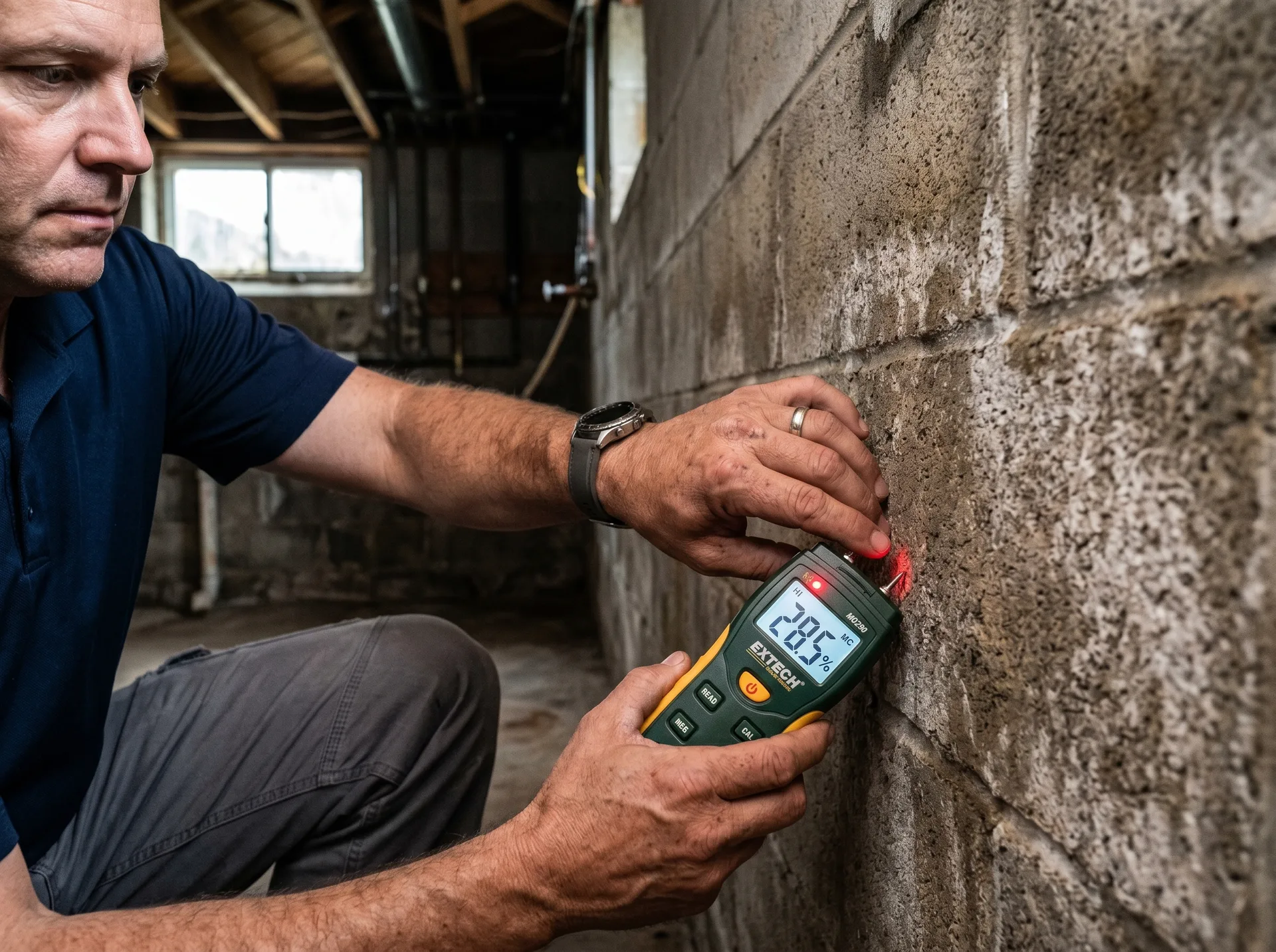
Moisture meter readings reveal elevated moisture inside building materials - often before any visible mold appears.
Independent. No Remediation Conflict.
Mastertech York does not perform mold remediation. That means the inspection results are never influenced by the potential to sell remediation services. You get an honest assessment of what's actually in your home.
Learn About Our InspectionsServing York County Homeowners After Every Wet Season
Tom inspects homes across York County, including York city and all surrounding townships and boroughs. Post-spring inspections are available for residential homes, rental properties, and commercial buildings. If your property had water intrusion, drainage issues, or moisture concerns this spring, a professional inspection can give you the clarity you need before summer humidity makes any existing problem worse.
Inspections are available in York, West Manchester Township, Springettsbury Township, Dover, Dover Township, Manchester Township, Red Lion, Dallastown, Hanover, Glen Rock, Windsor, Wrightsville, and all surrounding York County communities.
If you're in the York, PA area, Red Lion, Dallastown, or Hanover, call or text Tom directly to discuss what you're seeing and whether an inspection makes sense for your situation. If mold is found and remediation is needed, Tom's written inspection report gives any qualified remediation contractor the documentation they need to scope and price the work accurately. Once remediation is complete, post-remediation verification testing confirms the work was done correctly.
Related Resources
Mold Testing After Heavy Rains
An honest answer to whether you actually need testing after York County rain events.
Township Drainage and Mold Risk
How York County drainage problems connect directly to indoor mold growth.
10 Things to Know About Basement Mold
What every York homeowner should know before the next heavy rain event.
Spring Snow Melt and Basement Moisture
How spring thaw and snowmelt create basement moisture problems in York County.
Can Dehumidifiers Prevent Basement Mold?
What dehumidifiers can and cannot do when it comes to mold prevention.
What That Earthy Smell Usually Means
Understanding the odor that often follows a wet spring in York County homes.
Concerned About What This Spring Left Behind?
Describe what you noticed - water in the basement, a new smell, staining on walls. Tom can help you decide whether an inspection makes sense before summer humidity makes any existing problem worse.